

The College of Engineering offers four undergraduate and five graduate programs. Programs leading to Bachelor of Science and Master of Science degrees include Aerospace Engineering, Civil and Environmental Engineering, Electrical and Computer Engineering, and Mechanical Engineering. In addition, through a joint program offered by San Diego State University and the University of California, San Diego, students can work toward a doctoral degree in Engineering Science and Applied Mechanics. Enrollment in all College programs is approximately 1,550, including more than 200 graduate students.
In the Electrical and Computer Engineering department, Dr. Andrew Szeto, chair of the department, supervises two federally funded projects: one to bring appropriate technology to individuals with various disabilities and a second to provide transdisciplinary training in the emerging field of assistive technology. Dr. Szeto is also involved in studying mechanisms that underlie the speed of information processing that are presented to the tactile sense by means of mild electrical pulses. The potential application of this work lies in the design of better assistive devices that use the sense of touch for communicating important environmental information to persons who have significant sensory impairments.
Professor fred harris, Electrical and Computer Engineering, is involved in several areas of digital signal processing research. He is currently acting head of the Communications Systems and Signal Processing Institute which supports educational and research activities in communication systems with an emphasis on radio frequency and digital signal processing. Faculty, students, and industrial partners participate in developing cores of expertise in specific related areas meaningful to the technical community such as radio frequency circuitry, modems, receivers, transmitters, synthesizers, analog-to-digital and digital-to-analog converters, digital signal processing algorithms and hardware, antennae, and networks.
Also in the Department of Electrical and Computer Engineering, Dr. Paul Kolen has received a multi-year grant funded by the National Science Foundation to develop a motion capture system useful for sports training, motion study, and virtual reality applications. The system allows the physical motion of a human or animal subject to be captured for digital storage and/or real-time display on a video monitor. Applications for such a system include further investigation of motion analysis, prosthetic motion control, sports training, and aiding disabled persons and athletes.
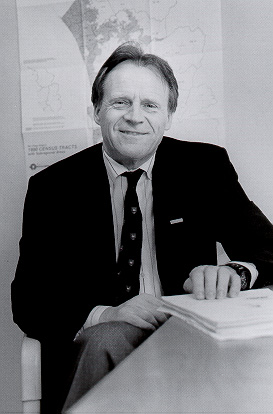
Commuters on I-15 will travel more easily, thanks to Dr. Janusz Supernak, chair of the Civil and Environmental Engineering Department, who continues his work as project director on the "I-15 Congestion Pricing Monitoring and Evaluation Project." The project, sponsored by the Federal Highway Administration and administered locally by SANDAG, will determine feasibility of using different versions of congestion pricing strategies as a tool to reduce traffic congestion and levels of pollution in metropolitan areas. The study is the first of its kind in the United States and will have a direct - and daily - impact on many San Diego area residents.
Dr. Sheila Sarkar is the director of the Network of Employers for Traffic Safety (NETS), a statewide organization funded by the California Office of Traffic Safety and devoted to increasing traffic safety awareness among companies in major metropolitan areas in California. The Institute builds on the success of the transportation program at San Diego State University and expands research into the transportation safety area and develops safety-related curriculum.
Dr. Subrata Bhattacharjee, Mechanical Engineering, continues to investigate the mechanism of flame spread in a microgravity environment. Fire safety is an important aspect of space travel because in the absence of gravity, fires inside a spacecraft may behave quite differently from fires on earth, which are dominated by buoyancy-induced flows. Experiments are conducted in free-falling elevators (drop-towers), in airplanes executing parabolic trajectories and in payloads carried by sounding rockets. The results of the experiments propose to explain the behavior of microgravity flame spread. One of the important findings of this project is the discovery of a new class of flames, called radiative flames, in a microgravity environment. Despite their small size, these flames have been found to transfer a significant portion of their energy through thermal radiation, a phenomenon usually associated with large-scale fires.
Summer 1997 was the second year of the highly successful Engineering and Science Residential Program. This eight-week summer program, funded by local industry and the U.S. Navy, is a unique opportunity for select 11th grade students in the San Diego area to master a team research project done on-site. The students also complete a college-level computer programming course, live on-campus, and make final oral presentations at the program's graduation ceremony.
Working with other colleges at SDSU and funded by a federal grant since 1994, the Defense Conversion Center retrains displaced defense industry professionals in the fields of telecommunications, digital hardware and software systems, and environmental engineering. The success rate for placing participants in the program is better than 90 percent and at an average salary of $52,000. In 1997 a certificate program in environmental engineering was added to the Center's programs.
Drs. Asfaw Beyene and Halil Guven, Mechanical Engineering, co-direct the Industrial Assessment Center in the College of Engineering. The Center provides energy and waste assessment service to small and medium-sized manufacturing companies in Southern California. By reducing process energy requirements in a cost-effective manner and minimizing the amount of waste generated in a facility, both the overall cost competitiveness of the company improves and the level of waste to dispose is reduced.
The art and science of engineering includes a strong element of public service to the community. The Energy Engineering Institute provides education in energy engineering to students and the community. Under the direction of Dr. Halil Guven, the Institute is a joint University, industry, and government venture that helps industry optimize energy efficiency through innovative research and development projects.
In 1996 the College of Engineering suffered the tragic loss of four well-loved and respected teachers and friends. Dr. Masako Suto, professor of electrical engineering and an expert in etching and chemical vapor disposition of microelectronic materials, died after an extended illness. Then, in August 1996, Drs. Chen Liang, D. Preston Lowrey, and Constantinos Lyrintzis were fatally shot by a graduate student about to defend his master's thesis. Each of the professors was a vital member of the faculty and each inspired their students to achieve their highest potential. Understandably, the entire University community - and especially the College of Engineering - felt the shock and loss of these four faculty leaders throughout the year.
|
Janusz Supernak
|